
Asset intelligence
Insights & Benchmarks
Understand condition trends, evidence confidence, continuous sensor evidence, recurring fleet patterns and comparative performance.
Visual example under review
The earlier Asset Insights preview contains loading errors and is not a successful-workflow example. It has been withdrawn from this chapter pending a fresh capture. The benchmark screenshot below remains an illustrative local example.
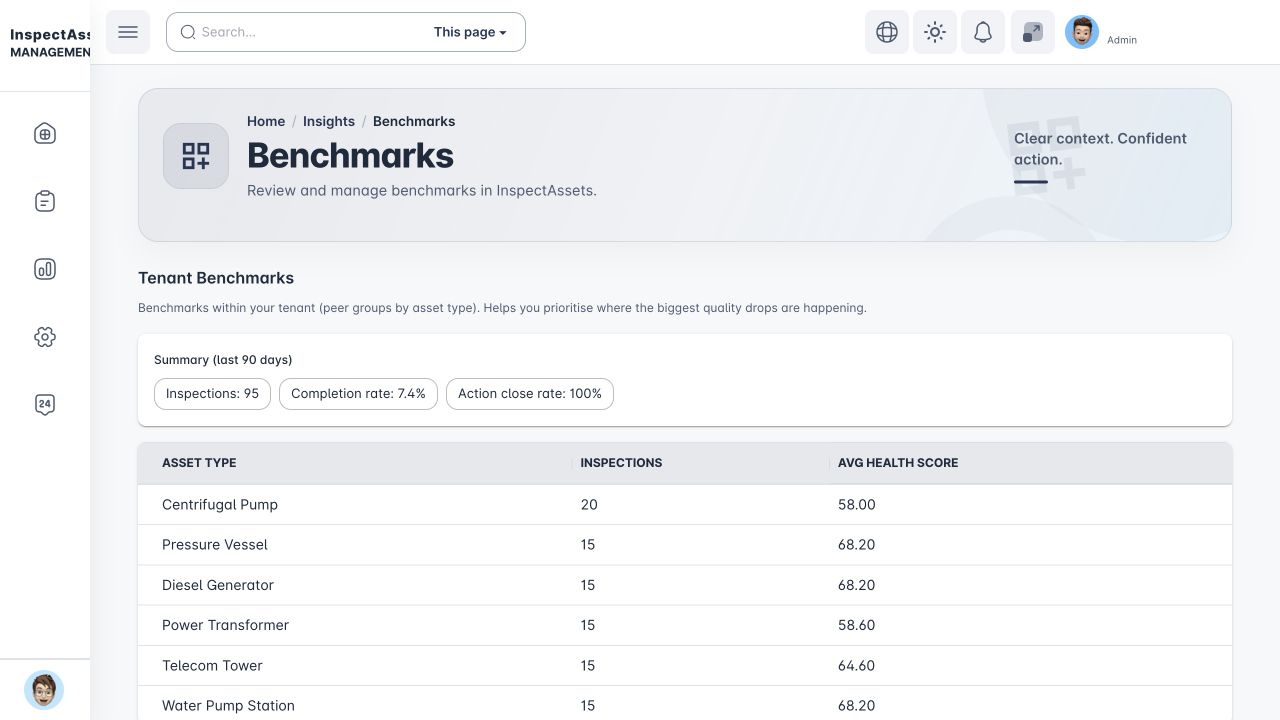
Insights need context
Trend lines and recommendations are strongest when the underlying inspection coverage and evidence quality are strong. Always distinguish a change in asset condition from a change in how much evidence was collected.
Asset Health Trend
The Current Health Score shows the latest calculated health result available for the asset. The trend shows how calculated health has changed across completed inspections over time.
When a trend changes sharply, open the underlying inspections and compare coverage, failures and limitations before concluding that the asset itself changed by the same amount.
Evidence confidence and uncertainty
InspectAssets separates evidence confidence from health. A strong condition result based on limited scope should be interpreted differently from the same condition result supported by complete inspection coverage and strong evidence provenance.
Continuous Condition Evidence
Where enabled, InspectAssets can receive machine evidence between formal inspections and connect it to the asset, Decision Readiness and operational follow-up. The dedicated Continuous Condition Evidence guide covers device/source registration, one-time credentials, telemetry, de-duplication, condition rules, event lifecycle, automated work, heartbeat/offline state and machine-evidence policies.
Machine evidence complements inspection evidence
It is optional by default and is treated as Not Applicable when no relevant machine-evidence requirement exists. A machine event can indicate that something changed between inspections, but it does not automatically replace the inspection procedure required by your control, maintenance or compliance regime.
Fleet patterns
Recurring patterns help identify issues that appear across several assets rather than treating every finding as an isolated event. Review the supporting records before standardising a response across the fleet; similar symptoms can still have different causes.
Smart Recommendations
Recommendations convert available evidence into a prioritised next-action view. Severity, confidence explanation and suggested action/SLA information help teams triage work. Use the recommendation as the start of a decision, then confirm the source records before creating or closing work.
Benchmarks
Benchmarking compares performance using the scope available to your organisation and plan. Tenant benchmarks should be read in the context of asset mix, criticality, inspection frequency and evidence completeness. Platform administrators can have separate cross-tenant benchmark views.
When there is no insight data
New assets and organisations may legitimately have no trend or pattern yet. Build a consistent history by conducting inspections, maintaining health/evidence records and syncing field work. A blank chart is preferable to inventing a trend from insufficient history.