
Assurance & obligations
Compliance
Turn standards and internal controls into traceable obligations, due dates and evidence instead of managing compliance as a static checklist.
Editing typically requires manage_tenant_settings or manage_asset_compliance
Evidence-led compliance
Compliance in InspectAssets connects requirements to the assets and evidence that demonstrate whether the requirement has been met. Packs help organise standards; the Compliance Obligation Engine adds structured frequency, due-date and evidence tracking.
Compliance Packs
A compliance pack groups related requirements, such as a regulation, recognised standard or internal control framework. Apply relevant packs to create a repeatable compliance baseline rather than adding every requirement manually.
From the pack view, authorised users can move into coverage and obligation tracking. Packs are the organising layer; the evidence register is where compliance becomes operational.
Compliance coverage
Coverage views summarise posture and identify gaps. Use them to find requirements that are not currently supported by the expected inspection or evidence record. A clean dashboard is only meaningful if the relevant requirements have actually been configured and applied.
Compliance Obligation Engine
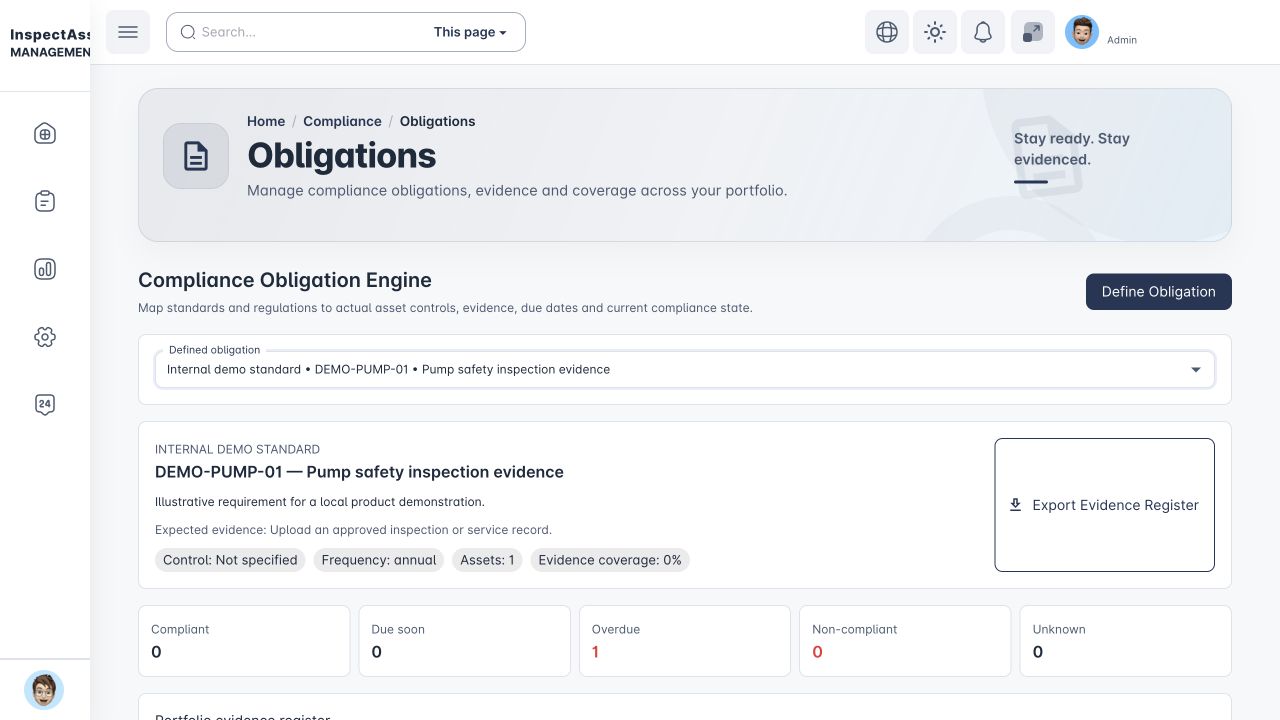
The obligation engine allows the organisation to define a compliance requirement in operational terms. A structured obligation can include:
- Standard or regulation and requirement code/title.
- The requirement text and applicable control.
- Frequency and first due date.
- Expected evidence.
- The assets to which the obligation applies.
This creates a portfolio evidence register rather than relying on someone to remember when a recurring control is next due.
Evidence register
The evidence register can show the asset, site, control, frequency, current state, next due date and latest evidence. When recording evidence, the user can capture the compliance result, completed/assessed date, evidence URL or reference/key, notes and the next due date.
How inspections support compliance
An inspection can supply evidence for a control, but a completed inspection is not automatically proof that every relevant compliance requirement has been met. Review the applicable obligation, expected evidence, inspection coverage and any unresolved limitations before relying on the result.
If the inspection identifies a failing condition or incomplete evidence, use Corrective Actions and the limitations workflow rather than closing the compliance gap prematurely.
Exporting compliance evidence
Where available, export the evidence register when a structured external or internal review needs a portable record. For a controlled external review containing selected inspections and evidence, use the External Auditor / Client Evidence Portal instead of broadly distributing internal access.
Configuration determines the result
A high coverage percentage can only describe the obligations that have been configured. Review standards, scope and asset applicability periodically so the compliance model continues to reflect the real obligation set.